Structure of mechanism |
| Function |
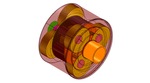
The system share the input torque(helice), which is transmitted to the output (generatrix). Indeed, the additon of a second planets stage allows to trasmit a bigger torque with the same epicyclic gear train, however improve his hyperstatism. So we must improve the manufacturing process to prevent the planets deformation (wear) or the shaft deformation. The inventor also proposes to add a differential after the two stage multiplier to correct these manufacturing defects , the differential allows to correct the actual difference of planets stage velocity . In conclusion, the lifespan of the elements is increased, and the number of maintenance intervention decreases sharply. |
| Comment |
Author : Violaine Leroy
Modified by : Khaled-Assad ARROUK
IFMA (French Institute for Advanced Mechanics) - http://www.ifma.fr
Clermont-Ferrand, France
This model was generated to explain a certain patent in more detail.
The model and all attached items were made within this context. |
| Dimension of mechanism |
planar |
| Number of links |
35 |
| Drive movement |
other |
| Degree of freedom |
1 |
| Fundamental mechanism |
 Gear containing mechanism |
| Number of inputs |
1 |
| Number of followers |
34 |
| Revolution ability |
yes |
| Revolution ability of input link |
yes |
| Relative position between drive and output |
parallel |
| |
Application |
| Application area |
Other fields |
| Examples of application |
This system have wind turbine applications. Indeed wind turbine, whiwh have low angular velocity (50 to 200 round/min), needs a multiplier to bring a sufficient angular velocity to the generatrix. However, due to the momentus torque, it's clever to add a diffrential to share it with a second planets stage. |
| |


 Newsletter
 Animations
 CAX files
 Documents
 Videos
 Images


 DMG-Lib

 Europeana

 IFMA



 Click to enlarge


