Structure of mechanism |
| Function |
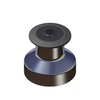
A manually powered winch has two geared drive trains. Both originate from a simple set of gear teeth (7) formed into the diameter of a drive input shaft (5). The final drive, common to both gear trains, to an internal gear track (18) on the drum (3) of the winch is one part (12) of a two part gear (8,12). The part (12) is directly borne by a hub (20) on an axle (10) in the winch. Its gear teeth are on the outer face of an annulus (22) on the inner face of which are ratchets (14) of a pawl-and-ratchet unidirectional drive (16) between the two parts (8,12). The other part (8) of the two-part gear is preferably borne not directly on the axle (10) but on the hub (20) of the part (12). |
| Comment |
Authors : Anne WEINLING
Modified by : Miguel PEREZ BORRAJO
IFMA (French Institute for Advanced Mechanics) - http://www.ifma.fr
Clermont-Ferrand, FRANCE
This model was generated to explain a certain patent in more detail.
The model and all attached items were made within this context. |
| Dimension of mechanism |
planar |
| Number of links |
23 |
| Drive movement |
Rotation |
| Degree of freedom |
1 |
| Fundamental mechanism |
 Gear containing mechanism Gear containing mechanism
 Friction based mechanism Friction based mechanism
 Screw containing mechanism Screw containing mechanism |
| Number of inputs |
1 |
| Number of followers |
1 |
| Revolution ability |
yes |
| Revolution ability of input link |
yes |
| Relative position between drive and output |
coaxial |
| |
Application |
| Application area |
Home Life/Leisure, Transport/Traffic and Various fields |
| Examples of application |
Sailboat |
| |


 Newsletter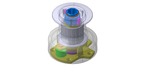
 Animations
 CAX files
 Documents
 Videos
 Images

 DMG-Lib
 Europeana
 IFMA
IFMA


 Click to enlarge


