 Click to enlarge Click to enlarge
|
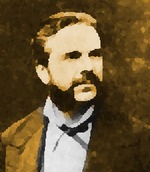
French scientist and inventor who is credited with the invention of telectroscope.
With the American George R Carey and the German Paul Nipkow, Constantin Senlecq is the researcher mostly quoted in the histories of the television. In France, any history of the television mentions his name in its introduction. A debate exists on the priority of idea between the American George R. Carey, the Portuguese Adriano de Paiva and Constantin Senlecq as regards the possibility of using the selenium for the transmission of the pictures. In the paper “the téléctroscope”, in 1877, he first mentioned the idea of using the selenium. In 1881, he published a sketch detailing George Carey’s idea in an improved form: two rotating switches were proposed between the panels of cells and lamps, and as these turned at the same rate they connected each cell, in turn, with the corresponding lamp. With this system, all the points in the picture could be sent one after the other along a single wire. This is the basis of modern television: the picture is converted into a series of picture. Constantin Selecq is a mythical figure of the history of the television.
|
| |
|
|
variant spelling:
SENLECQ, Constantin
|
| |
|
|
|
Curriculum vitae
|
|
|
* 1842
|
Fauquembergues
|
born
|
|
1877 - 1878
|
|
Senlecq s'attribue la création du terme télecroscope, alors que la première attestation est l'article de Figuier publié en 1878. (FIGUIER, Louis, « Le télectroscope, ou appareil pour transmettre à distance des images », L’Année Scientifique et Industrielle, 21, n°6, "Année 1877", Paris, 1878, pp.80-81.).
|
|
07.02.1881
|
|
"The Telectroscope" article dans The Electrician, vol. 6, p. 141.
|
|
07.04.1881
|
|
SENLECQ, C., Le télectroscope, avec notes traduites de l'anglais par l'auteur, Typographie M. D'Homont, Saint-Omer, 1881, 36 p. : Brochure publiée à compte d'auteur par Senlecq pour défendre sa position. Parue dans l'article de The Electrician.
|
|
1907
|
|
Une présentation du nouveau télectroscope de Senlecq;, "The Senlecq telectroscope, an apparatus for electrical vision" paraîtra dans le Scientific American Supplement 1907,64 (p.372-373). Shiers (1997, p.49) commente ainsi cet article : « Dans cette adaptation du disque de Nipkow l'inventeur emploie des cellules séparées ou en plus de sélénium au lieu de trous dans un disque de cuivre. Signaux provenant de chaque cellule à son tour, est envoyé par l'intermédiaire d'une bobine d'induction à un galvanomètre de type solénoïde qui exploite une transparence ombrée pour moduler la lumière provenant d'une lampe dans un récepteur. Le faisceau modulé est ensuite passé à travers les trous dans un disque de balayage et projetée sur un écran de visualisation. Pas de méthode spécifique pour le synchronisme est mentionnée, mais il est prévu une vis pour régler la vitesse du disque au niveau du récepteur. "
|
|
1907
|
|
Dépôt de brevet pour un appareil destiné à transmettre à distance, par l'électricité, la vision avec le mouvement et l'instantanéité.
|
|
1907
|
|
Publication d'une proposition d'enregistrement des images sur fil d'acier, de l'enregistrement sur bande magnétique et qui était peut-être inspirée par le télégraphone de Poulsen permettant l'enregistrement du son sur fil d'acier (1900). Champeix indique que la méthode proposée par Senlecq a été décrite par A. Turpain dans « Notices fondamentales de télégraphie », Gauthier-Villars, 1910.
|
|
1909
|
|
Invention du magnétoscope et dépôt d'un brevet : système d'enregistrement des images sur un fil magnétique.
|
|
† 1934
|
Ardres
|
died
|
|
|


 DMG-Lib
 Europeana