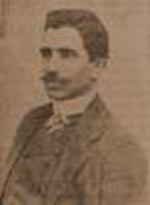
 Ansicht vergrößern
|
Romanian engineer and physicist
Marian Victor, the late Romanian historian of physics, described the engineer-physicist Augustin Maior as a man who was talkative, funny, dynamic, much loved by his students. Add the attraction that he exerted on those around him by his encyclopedic culture. In the annals of world science, Augustin Major is still under a great injustice. Even though he is the undisputed creator of multi-phone (which would transmit several calls on one track) - turning point of modern telecommunications development - his contribution is consistently omitted or minimized in the literature, its priority being assigned to a later inventor.
But let us see who this worthy son of Transylvania was. He was born in Reghin, as son of a teacher and attended high school in his hometown, Tg. Mures then Budapest, developing an original work on Electrical still being in school. He graduated the Polytechnic School in Budapest (1905) as engineer, but also heard the physics and mathematics courses in Vienna, Munich and Göttingen ("private student"), taking note of the great achievements of the early century on Planck's theory about quantum mechanics and Einstein's relativity.
In 1905, Augustin Maior was employed as engineer at the Electricity Laboratory of the General Directorate of Posts in Budapest. After World War I, he was for a short time (1919-1920) General Director of the Post, Telegraph and Telephone in Transylvania and leader of the first School of Telegraph and Telephone in the province reunited with the country in 1913. He became, during many decades, professor of theoretical physics at the University of Cluj (1920-1956), designated as the first chair of this specialty in Romania.
In the early years of XX century, the phone knew a considerable expansion, but the existing network could not cope with the growing needs of telecommunications. The directions of research have turned to increase the transmissions capacity, namely the multi-phone, but the results were unsatisfactory. After many trials of different specialists, unsuccessful or only partially succeeding, the first one who theoretically developed a new system and the operational station, using high frequency alternative carrier currents, was the Romanian engineer and physicist Augustin Maior. In 1906, he managed to transmit firstly two, then five calls on the same telephone circuit on a line 15 kilometers long. In 1907, he published his results and diagram of the multi-phone system in the best-known journal of the times ("ElektrotechnischeZeitschrift" - ETZ), and next year he presented an appropriate communication to the first Conference of Engineers P.T.T. However, the English magazine "The Electrician", in March 1911 as well as other publications, credited the American major George Owen Squier with inventing multiple telephony. The later accomplished, four years after Augustin Maior, in 1910, another multi-phone system, more primitive, which transmitted only two calls on a much shorter cable. Squier succeeded, shortly thereafter, to industrialize and to commercialize his new technology.
It is worth to remember, that Augustin Maior, beside his major invention, brought scientific contributions in Electrical, relativity and thermodynamics of radiation. He early foresaw electrical energy transmission over long distances by high frequency currents. In the quantum theory, he introduced a new feature called "quasi-entropic".
|
| |
|
|
Schreibweisen:
Maior, Augustin
|
| |
|
|
|
Lebenslauf
|
|
|
* 1822
|
Reghin, Romania
|
geboren
|
|
1905
|
Budapest
|
Engineer
|
|
† 1964
|
|
gestorben
|
|
|


 Newsletter


 DMG-Lib

 Europeana

