Structura mecanismului |
| Funcţie |
The innovation involves specifications of shape, number, and position of ribs linking the blades of the windmill with its vertical axis, connected to an electric generator. To be able to show its activity from a practical point of view, a reduction gear has been applied at the end of the axis. The mechanism has been designed to turn the strength applied by the wind on the blades into a movement which frequency and torque are controled by the gearbox |
| Comment |
Author : Niels Peyre
Modified by : Khaled-Assad ARROUK
IFMA (French Institute for Advanced Mechanics) - http://www.ifma.fr
Clermont-Ferrand, France
This model was generated to explain a certain patent in more detail.
The model and all attached items were made within this context. |
| Dimensiunea mecanismului |
plan |
| Numărul de elemente |
5 |
| mişcarea de antrenare |
Rotaţie |
| Grad de libertate |
1 |
| Numǎrul elementelor de intrare |
1 |
| Numǎrul tacheţilor |
3 |
| Posibilitatea unei rotaţii complete |
da |
| Posibilitatea unei relaţii complete a elementului de intrare |
da |
| Poziţia relativǎ dintre intrare şi ieşire |
coaxial |
| |
Aplicaţie |
| Domeniul de aplicaţie |
Production |
| Exemple de aplicare |
The windmills are used by well-known companies in the energy production field such as Areva or GDF-Suez to produce energy with no CO2 emission. A lot of small companies try to propose small sized units adapted to low comsumption for private use and/or in isolated areas. Vertical axis windmills have the advantage to be able to be used in areas subjected to turbulent wind flows thanks to their structure. |
| |


 Newsletter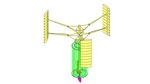
 Animations
 CAX files
 Documents
 Videos
 Images

 DMG-Lib
 Europeana
 IFMA
IFMA


 Click pentru a mări


